
The original Alpex earned its place on a lot of rifles the hard way, and the 4K that followed became something close to the default digital day/night scope for stalkers and foxers alike. Now Hikmicro has released the Alpex Pro, and with it the familiar question every owner of last year's model is asking: do I actually need this? We take a look at the A50PL and try to answer that honestly.
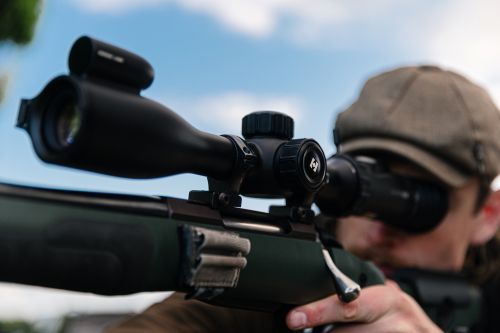
Digital day/night scopes occupy an interesting middle ground. They are not thermal, and they are not conventional glass, but for anyone whose work runs from last-light deer through to lamp-free foxing, they have become a genuinely practical one-scope solution. Hikmicro has arguably done more than anyone to drive prices down and capability up in this corner of the market, and the Alpex line is the reason many stalkers made the jump from traditional optics in the first place. This is because a good digital unit will squeeze useful identification out of the last ten or fifteen minutes of legal light, when even expensive glass is starting to give up.
The Alpex Pro A50PL is the new flagship of that line. With a recommended retail price of around £850 for the rangefinder model, with prices already dipping below that, it sits above the outgoing Alpex 4K, below the dearer thermal offerings, and squarely against rivals such as the DNT Zulus and the NocPix digital units. That is serious money, but not silly money, and the spec sheet goes some way to justifying it.
The Pro carries a 12-megapixel detector behind a bright 50mm F1.8 objective. In practice, more pixels mean cleaner edges and better separation of an animal from a dark hedge line. The image is delivered to your eye via a larger 0.6-inch AMOLED display with a redesigned eyepiece, which noticeably reduces the "looking down a drainpipe" tunnel effect that puts many people off digital scopes.
Hikmicro's new Light Pro processing handles exposure, noise and detail automatically across day, night and auto modes, and the company claims low-light performance equivalent to a much faster aperture. Marketing claims aside, the practical point is that the scope holds a usable full-colour image deeper into dusk before you need to switch to black-and-white night mode and reach for the infrared illuminator.
Beyond the imaging, the A50PL carries an onboard laser rangefinder good to a claimed 1,200 metres with metre-level accuracy, feeding a ballistic calculator that you set up through the phone app and which then offers a corrected aim point on screen. Base magnification runs from 4x with digital zoom beyond, the chassis is a conventional 30mm tube that takes ordinary mounts, and the whole thing weighs 889 grams even with the rangefinder module, which is 300 grams lighter than the outgoing Alpex 4K. Power comes from internal batteries plus a removable 18650 cell, for a quoted 7 hours or so of running.
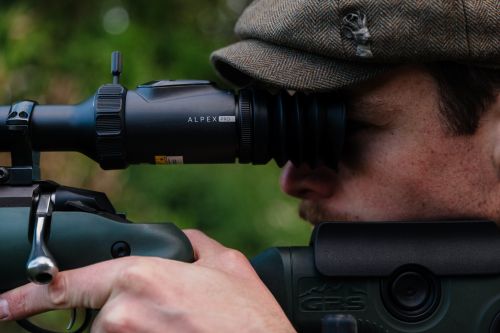
Handling is where the Pro makes its best first impression. The 30mm tube mounts like a normal scope, sits lower than the old model thanks to a slimmer objective bell, and the revised zoom and focus controls feel much closer to conventional glass than the button-prodding of earlier digital units. Fit and finish are a clear step up, right down to the metal lens cover; it no longer feels like an electronic gadget strapped to a rifle.
Furthermore, zeroing is straightforward. The freeze-frame zero function lets you hold the image still while you walk the reticle onto the point of impact, which turns the job into a few minutes' work. We found that adjustments now track properly and predictably, worth noting as this was something that was occasionally hit and miss on the 4K. Additionally, multiple zero profiles mean the scope can move between rifles or loads without drama, which should also appeal to anyone running it across a rimfire and a centrefire.
Daytime image quality is the biggest single improvement. We found that the daylight and twilight picture is on a different level to predecessors, with colour rendition and sharpness that get surprisingly close to mid-range glass out to sensible deer distances. Where it gets more interesting is in genuinely low light. Now, the Alpex 4K earned much of its reputation on its ability to gather light at the very end of the day, and that remains the benchmark many of us still measure against. From what I have seen, and from conversations with other users, the Pro appears to match the 4K in those last few minutes, with some arguing the older unit still has a slight edge. However, with the illuminator on after dark, the higher-resolution sensor pays its way, but anyone buying purely for those last-light gains over a 4K should look through both before parting with their hard-earned cash.
Additionally, the rangefinder and ballistic calculator work well together, and the Bluetooth link to the app is quick and stable. Recoil-activated recording, with audio, captures each shot to onboard memory which is useful for cull records, teaching, content or simply settling arguments about where the shot placement was.
Interestingly, Some have found the finer reticles, particularly the ballistic hold-off marker, easy to lose against a busy or grainy background. There have also been comments around battery behaviour, with the unit draining the small external cell first and not always handing over cleanly to the internal supply. Furthermore, a few early reports mention settings reverting after restart, although zero appears to remain intact, and recoil-activated recording has not always caught the shot on early firmware.
None of this would put me off entirely, and Hikmicro has a decent record of tidying these things up through updates. But it does underline the usual truth that early adopters often help finish the testing.The other point is not a fault, but a matter of fit. With slightly higher base magnification and a narrower field of view than the 4K, the Pro feels better suited to open ground than tight woodland. For close muntjac work in cover, that is worth thinking about.
It would be wrong to ignore the wider frustration around thermal and digital optics. The pace of change has become relentless, with a new flagship appearing almost every season. Increasingly, we hear the same complaint from stalkers and night-shooting customers being a level of fatigue at feeling pushed towards another upgrade, and annoyance at watching a perfectly good £800 scope lose a large chunk of its value the moment the next model is announced.
That frustration is understandable, and manufacturers would be wise to listen to it. But there is always two sides to an argument. This same competition has driven prices down and performance up at a remarkable rate. Not long ago, the capability now available for around £850 would have cost several times that. It also means yesterday’s flagship, often still an excellent scope, can now be bought second-hand for far more sensible money.
That said, the Pro does feel like a genuine step forward rather than a lightly updated version of what came before. The sensor, display, weight and handling are all noticeably improved. But it is evolution, not revolution, and it certainly does not make a well-zeroed Alpex 4K obsolete.
The Alpex Pro A50PL is a very good digital day/night scope and, for the right shooter, one of the most complete packages currently available at this price. It is lighter, sharper, better finished and easier to live with than the models that came before it.
For anyone coming to digital night shooting for the first time, or moving up from an early Alpex, an A50 or one of the budget alternatives, it is an easy scope to recommend. For existing 4K owners, the case is less clear. If most of your shooting is woodland stalking inside 100m, the upgrade becomes harder to justify. Likewise, if unassisted last-light performance is your main priority, look through both before buying.
The Pro deserves much of its early praise, but there are two sensible caveats. The firmware still needs a little maturing, and the low-light gains over the 4K are more modest than the marketing might suggest. Buy it because it suits your ground, quarry and style of shooting, not simply because it is the latest model. And if your current scope is still putting deer in the larder, there is no shame at all in letting this product cycle pass you by.
Don’t forget, if you’re new to using thermal or night vision equipment, or looking at getting your night shooting license, make sure to check out the Night shooting Course (NSC) here: Night Shooting Course